
mAbs
Addressing the challenges of monoclonal antibody production with magnetic separation
The use of monoclonal antibodies (mAbs) as therapeutic modalities has surged over the past few decades. These therapies are now pivotal in medicine, providing more effective treatment options for a wide array of conditions.
While ongoing efforts to improve the manufacturing often focus on upstream bioprocessing enhancements aimed at generating higher cell mass and boosting volumetric mAb productivity. Only a few solutions address the problems of existing legacy technologies for clarification and the throughput problems they install on the downstream methods, as well as for the overall process.

There is a clear need for innovation in cell clarification and downstream bioprocessing in order to resolve bottlenecks that create challenges and impact the overall efficiency of the process. Especially, high cell mass represents a severe challenge for the clarification step in the mAb manufacturing process. Generally, this step is costly, time intensive and can potentially cause elevated impurity levels. Clarification steps reach their limitations at high cell densities, resulting in insufficient removal of solid particles, filter clogging or poor utilization. This cause long processing times and costly pre-treatments during the mAb manufacturing. The following steps depend on the full removal of solids, otherwise the column chromatography steps would collapse and the costly resin would be destroyed.
In essence, todays mAb manufacturing relies on clarified supernatant for processing. However, the process improvements on the USP side make it increasingly more difficult to deliver clarified supernatant to the DSP side. There is a need for a breakthrough cross-over technology that is able to improve yields and overall productivity by seamlessly integrating upstream and downstream bioprocessing.

Advantages of magnetic separation
Magnetic separation based processing of monoclonal antibodies utilizes superparamagnetic magnetic beads. This emerges as a promising solution, capable of achieving clarification and Protein A capture in a single step, directly from crude cell broth. Here the free floating magnetic beads capture the mAb directly from the cell broth without prior pretreatment. The system copes with a high particle count in the suspension without shown signs of negative interference during the adsorption process. After the rapid capture of the mAb onto the magnetic beads, both can easily be separated from the rest of the cell broth through an external magnetic field. Beads and mAbs are retained in the magnetic field while cell broth and impurities are washed out. Once all impurities and residues are removed the mAb is easily eluted through buffer displacement and is highly concentrated collected. This method has the ability to replace both centrifugation and depth filtration, integrating the harvest step with Protein A affinity purification.
By doing so, magnetic separation has the potential to significantly enhance yield, throughput, and productivity, while minimizing downstream bottlenecks such as dilution, buffer management, filter clogging, and stoppages.
- 1-step cell clarification and capture directly from crude cell broth
- Replaces centrifugation and depth filtration
- Highly efficient under gentler conditions
- Improved yields, throughput, and productivity
- Reduced downstream bottlenecks to unleash the power of holistic bioprocessing

Superior mAb clarification and capture by magnetic separation
In a recent study, MAGicBeads mAb previous LOABeads PrtA, high-capacity magnetic Protein A agarose beads, were used to develop a new process for purifying mAbs from non-clarified CHO cell broth using a pilot-scale magnetic separator.
Pilot-scale testing showed similar mAb adsorptions in cell broth and clarified supernatant. In fedbatch runs, rapid mAb adsorption (≥96.6%) was observed, achieving 86% yield and 16 times concentration. The process, bypassing standard cell clarification and capture, yielded mAb purity comparable to column chromatography with very low HCP content (<10 ppm). This single-step method offers significant savings in resources, time, and equipment.
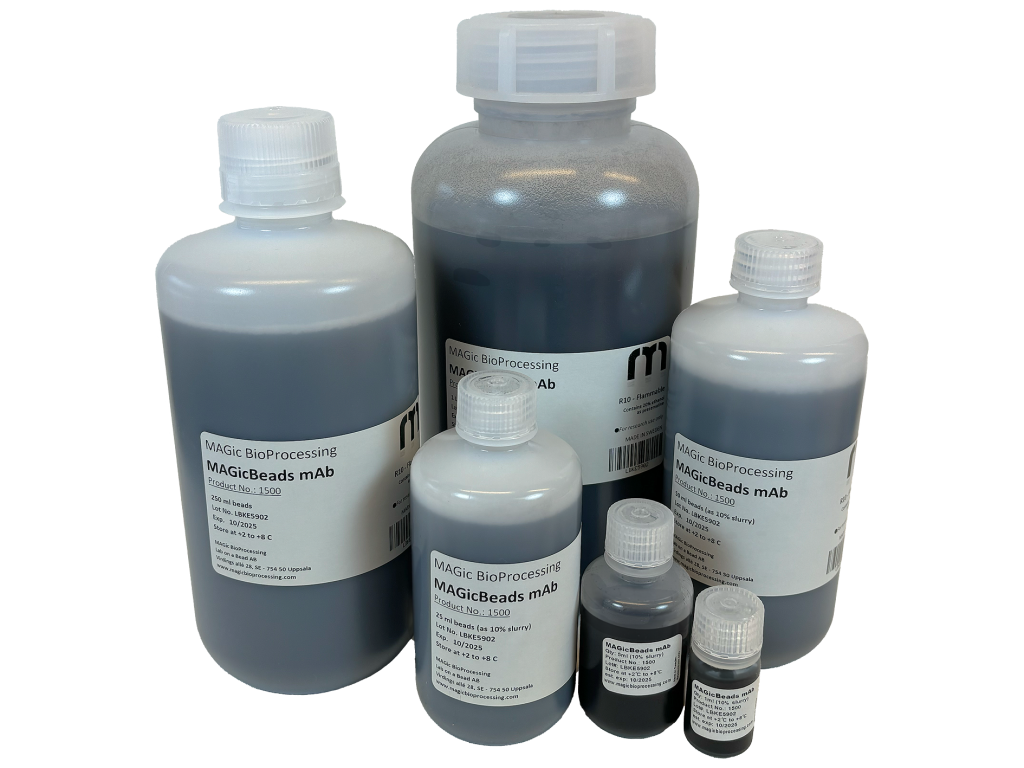
MAGic Beads for antibody purification
MAGicTM Beads Protein A are super-paramagnetic, agarose-based beads with a large surface area containing an alkali-resistant Protein A ligand, optimized for purifying monoclonal antibodies directly from cell broth.
The high binding capacity and matrix stability, make them suitable for repeated purification cycles without performance loss after cleaning with 0.5 M NaOH.