
Cell Therapy
Cell therapy challenges
Advanced Therapy Medicinal Products (ATMP), such as stem-cell-based therapies, have gained a rapidly growing interest for the treatment of severe, often incurable, diseases. The regeneration potential of stem cells is enormous and future therapies to repair damaged cell tissue have only begun to be exploited.
The advances in research and development for stem-cell-based therapies have created an increasing demand for reliable cell isolation methods that are efficient, robust, opera- tionally simple and generic while ensuring the cell’s biological functionality and safety. In particular allogeneic therapy approaches in form of human induced pluripotent stem cells (hiPSC) have experienced a major uptick in both research and clinical development. hiPSCs have unique properties, which make them highly attractive for cell-based therapies. They are able to unlimited self-renewal, differentiation into all three germ layers, except reproductive cells and originate from somatic cells (adult tissue) which does not present an ethical dilemma. hiPSCs have the potential to be the blueprint for off-the-shelf cell therapy.
Using off-the-shelf allogenic therapies will increase the availability to the patient as well as it allows for a significant cost reduction. With the increased patient size, large batches of cells need to be produced to supply the large number of patients.

Treatment safety is crucial, and a major concern is the elimination of unwanted cells prior to transplantation. Especially, hiPSCs introduce safety concerns that need to be address during the manufacturing. hiPSCs commonly originate from a non-homologous donor which can provoke the patient’s immune responses leading potentially to graft versus host disease (GvHD). Even more critical are undifferentiated cells, originating from the differentiating process of the hiPSCs to generate the desired cell type. Administration of unwanted or undifferentiated cells can provide a risk of teratoma formation and uncontrolled growth of the therapeutic cells.
This makes treatment safety a critical attribute and the elimination of unwanted cells prior to the administration to annihilate the chances of teratoma formation a major concern. Targeted isolation of the unwanted cells is an important tool for their removal and to ensure the safety. Currently there are no commercial methods available to accommodate targeted cell removal at large scale.

Advantages of magnetic separation
Today, for targeted cell isolation, two main methods are used, magnetic separation and Fluorescence Activated Cell Sorting (FACS) Both methods rely on the direct or indirect labelling of cellular biomarkers, for instance surface receptor proteins. While FACS utilizes fluorescence con- jugated antibodies, magnetic separation use antibodies conjugated with magnetic particles for the isolation.
FACS usually enables the processing of multiple high purity subpopulations but suffers from substantial cell loss, long processing times and costly equipment. In comparison, magnetic separation processes larger cell quantities with rather high throughput rates, lower cell loss and faster processing time and only requires a magnetic field for the isolation of subpopulations. Unfortunately, a lower purity is typically obtained compared to FACS. Today, the relatively small volumes handled by magnetic separation or FACS systems might be unsuitable to solve the bottleneck of large scale allogenic manufacturing.
- 1-step cell isolation and purification
- Highly efficient under gentler conditions
- Improved yields, throughput, and productivity

Enabling off-the-shelf cell therapy products
Magnetic separation can offer a process-innovating, scalable technology in cell therapy manufacturing of allogeneic therapies. MAG-SP is the world’s first truly scalable magnetic separation platform that utilizes metallic iron-based super-paramagnetic agarose beads to effectively collect stem cells and purify the cell therapeutic product in a gentle and highly scalable manner.
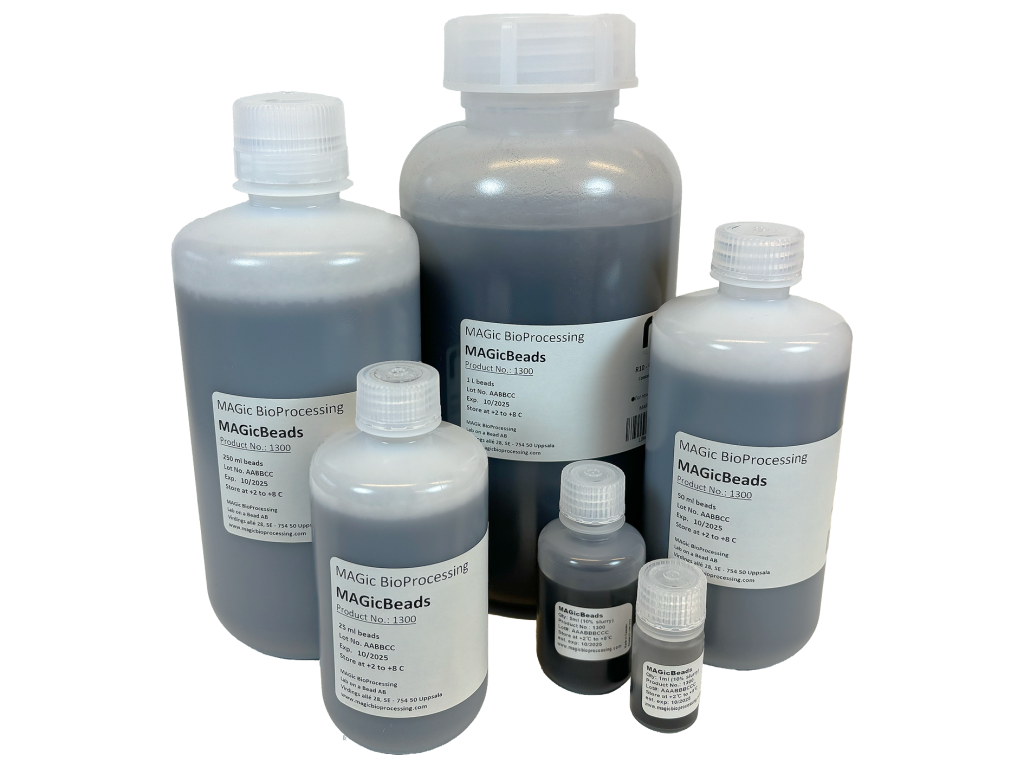
MAGic Beads for cell therapy
MAG-SP is the world’s first scalable magnetic separation platform that utilizes super-paramagnetic agarose beads to effectively collect stem cells and purify the cell therapeutic product in a gentle manner. MAG-SP enables the cost-effective scale-up of the cell manufacturing process and has the potential to realize the promise of off-the-shelf cell therapy products without risk of internalization.