
mRNA Purification
High-Capacity Magnetic Affinity Capture.
Capture poly(A)-tailed mRNA in a magnetic batch format. Run many batches in parallel – no packed column, no serial chromatography runs.
mRNA has become a flexible platform for vaccines and a growing range of therapeutics. Its sequence can be rapidly adapted to new pathogens or antigens, and the clinical success of mRNA vaccines during the COVID-19 pandemic accelerated work on other infectious diseases and therapeutic areas. That puts new demands on downstream purification, which has to keep pace with the number and diversity of mRNA constructs being produced.
Introducing MAGicBeads Oligo(dT), super-paramagnetic porous agarose beads functionalized with an 18-mer oligo(dT) ligand. Combining the selectivity of oligo(dT) affinity capture with a high binding capacity of ≥ 2.5 mg mRNA per mL settled beads, MAGicBeads Oligo(dT) deliver performance comparable to high-capacity chromatography resins. Purification is performed in a simple batch process, i.e. bind, wash and elute. Instead of packing beads into a column, they are efficiently collected using a magnet, which is an approach that can be advantageous when working with large molecules such as mRNAs.
MAGicBeads Oligo(dT) can be used to purify mRNA from a broad range of starting materials, including IVT-synthesized batches, total RNA preparations, and crude feeds. This versatility enables the same purification platform to support diverse mRNA workflows and production stages.
MAGicBeads Oligo(dT) combine high-capacity mRNA capture with the simplicity and flexibility of magnetic batch purification.

Addressing the Challenges of mRNA Downstream Purification
mRNA is often produced by in vitro transcription (IVT) from a DNA template. Alongside the full-length product, the reaction mixture contains truncated RNA, residual DNA template, enzymes, unincorporated nucleotides and double-stranded RNA (dsRNA). These must be removed while maintaining mRNA recovery, integrity and activity. The choice of purification method depends on production scale and quality requirements, with both therapeutic- and molecular biology-grade workflows having their own limitations.
Chromatography
Chromatography resins are often flow-restricted and challenging for small-scale parallel applications, such as high-throughput screening. Feed must typically be 0.22–0.45 µm filtered to prevent column clogging, while custom columns require specialized packing expertise.
Monoliths/membranes/fibro
These methods are not flow-rate limited but can be challenging to scale due to the fixed volumes and formats of the cassettes. They also tend to have high buffer consumption and limited process flexibility. Furthermore, parallelization is generally not feasible.
Magnetic formats – not scalable and biological compatibility
Magnetic beads enable parallel processing but offer low capacity at low bead concentrations and often require aggressive anti-aggregation additives and LiCl, increasing mRNA costs. Conventional oligo(dT) magnetic beads are typically <5 µm, limiting scalability to larger-scale applications.
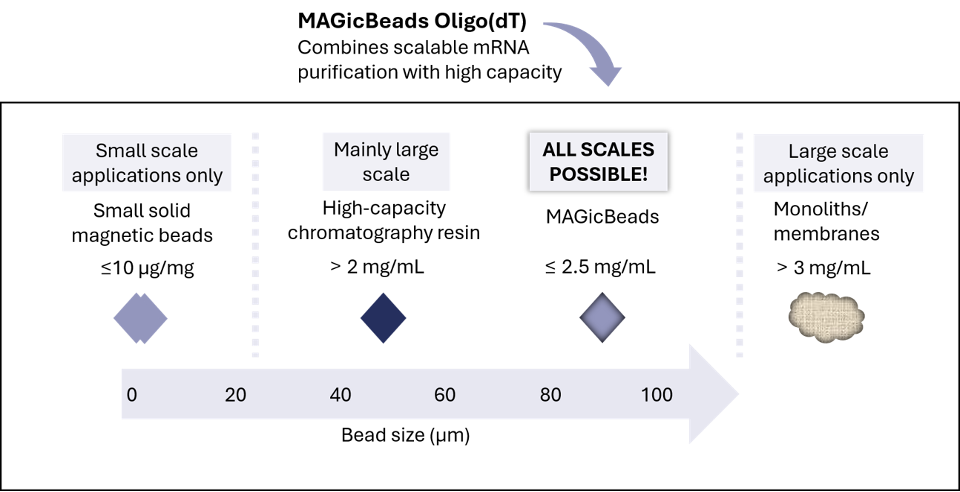
Oligo(dT) capture formats by bead size and binding capacity. MAGicBeads Oligo(dT) combine scalable magnetic handling with high capacity.
|
Compared with |
Advantage of MAGicBeads Oligo(dT) |
|---|---|
|
Oligo(dT) resin |
Faster mass transfer, simpler separation, no sample pre-filtration |
|
Oligo(dT) membrane |
Higher effective capacity per volume and a simpler batch process |
|
Fibre-based oligo(dT) units |
More flexible batch process, simpler recovery and handling |
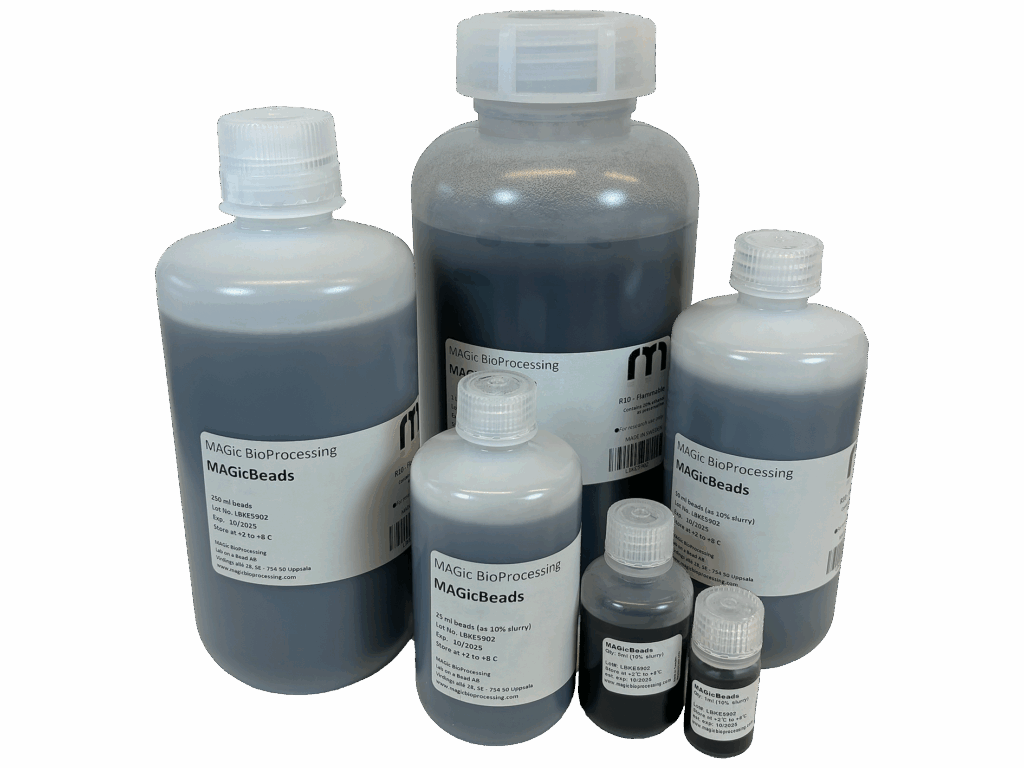
MAGic Beads for mRNA purification
Increasing mRNA Potency Is Driving a Shift Toward Smaller, More Parallelized Manufacturing
There is a trend toward increasingly potent mRNA designs, with some next-generation constructs achieving substantially higher protein expression per molecule than earlier applications. As potency increases, required mRNA doses may decrease, potentially shifting early-stage and preclinical production from milligram-scale toward tens or hundreds of micrograms. This would favour smaller, more parallelized manufacturing workflows rather than a few large batches, potentially making conventional FPLC-based processes, including chromatography resins and monolith/Fibro cassettes, less suited to future production needs.
This is where MAGicBeads are a natural fit: they enable a compact, scalable purification workflow that can be readily adapted to small-volume, parallelized mRNA production without the infrastructure and consumable requirements associated with conventional chromatography-based processes.
What is needed is an oligo(dT) capture format with chromatography-level capacity and the parallel, automation-friendly handling of magnetic beads.
MAGicBeads Oligo(dT) – Affinity Capture Without the Column
MAGicBeads Oligo(dT) are super-paramagnetic porous agarose beads (average particle size 90 µm) functionalised with a poly(dT) 18-mer through a proprietary linker. The highly porous matrix provides an available surface area of about 50 m² per mL, which is the basis for the high binding capacity and due to its intrinsic nature minimizes non-specific interactions. A saturation magnetisation of 40 emu/g and zero magnetic remanence give fast capture on the magnet and easy resuspension once the magnetic field is removed.
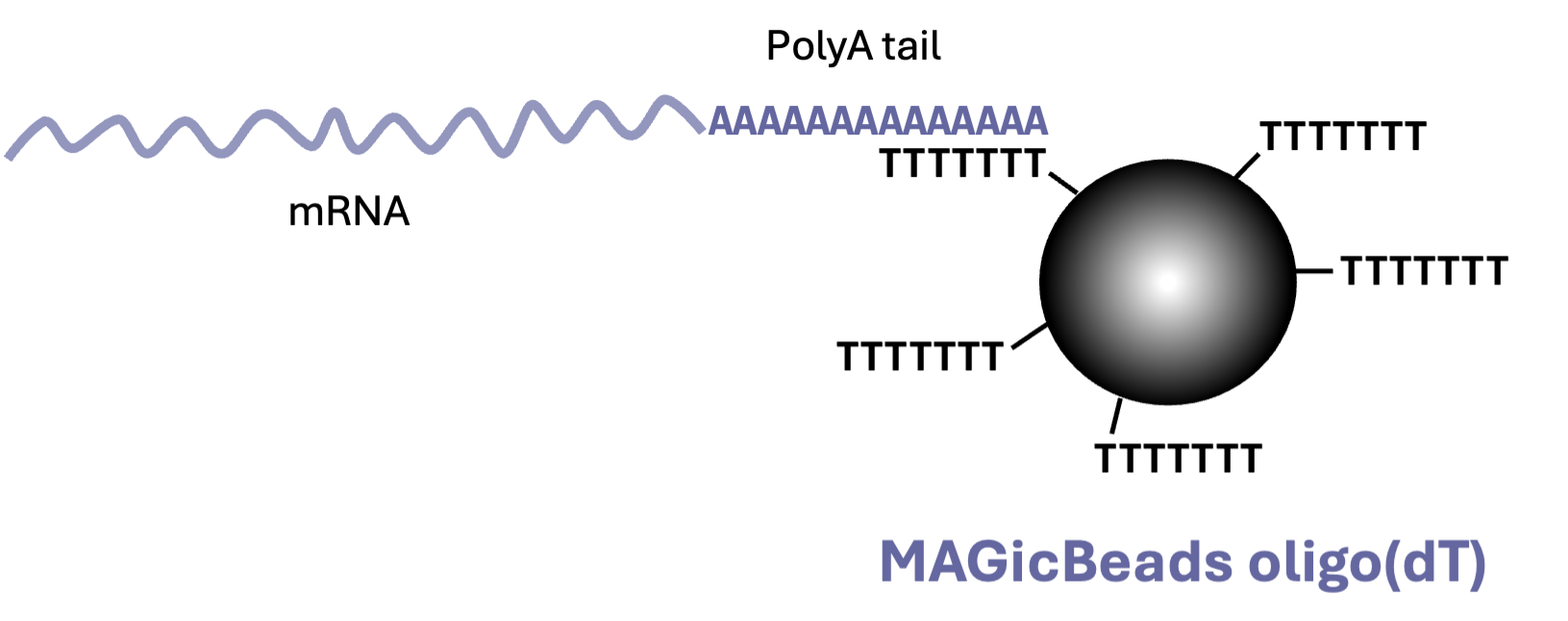
The oligo(dT) sequence hybridizes to the poly(A) tail at the 3′ end of the mRNA.
mRNA binds in presence of high-salt while all process-related impurities, such as non-polyadenylated RNA species, plasmid or linear DNA template, enzymes and unincorporated nucleotides, are removed in the wash steps, and purified mRNA is released under low- or no-salt conditions. Both binding and elution are performed at room temperature using standard buffers without harmful additives, enabling a simple and flexible purification workflow suitable for both therapeutic- and molecular biology–grade mRNA production.
As with any oligo(dT) method, selection is based on the poly(A) tail. Species that also carry a tail, such as 5′-truncated transcripts and some dsRNA by-products, can co-purify and may require a polishing step depending on the target specification.
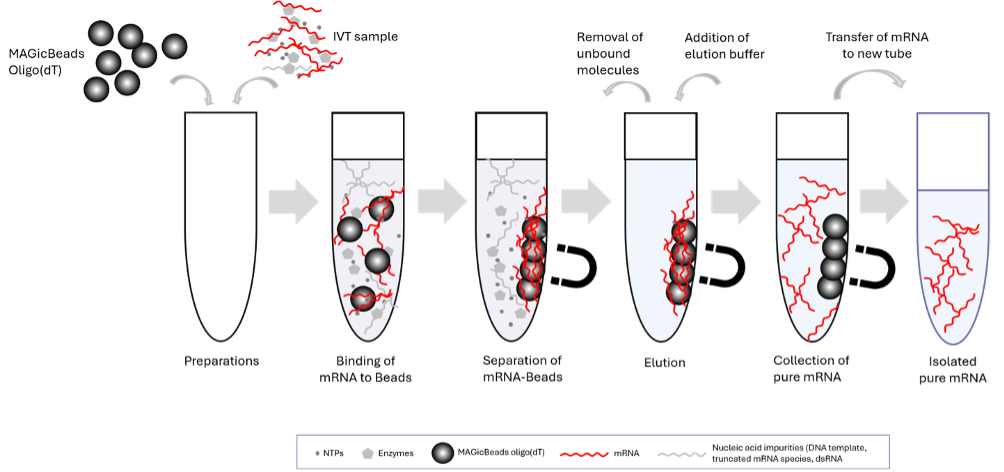
mRNA purification workflow with MAGicBeads Oligo(dT): bind, separate, remove unbound molecules, elute.
High binding capacity
Binding capacity of ≥ 2.5 mg mRNA/mL settled beads, determined across a diversity of mRNA constructs. Capacity decreases with increasing mRNA length, and there is a trade-off between capacity and yield.
Recovery
Up to 1 mg 2000 nt mRNA loaded/mL beads: >80% recovery
Up to 2.5 mg 2000 nt mRNA/mL: beads 60% recovery
mRNA integrity
Beads are supplied RNase-free and show no decay
post purification.
Why MAGicBeads Oligo(dT)?
Traditional chromatography formats were built for a small number of large batches. MAGicBeads Oligo(dT) is designed for the situation many early-stage mRNA labs might face in the near future – multiple constructs, small amounts per construct and the need for parallelized processes, while still supporting large production scales when needed. One bead for early scale discovery to large scale processing!